10 training principles that made me an above-average club player, part 1: at the table
Part 1 covers how I set up my practice sessions; part 2 covers your mindset, your plan and your matches.
Bas van KaamMaker of Frame, or Fortune?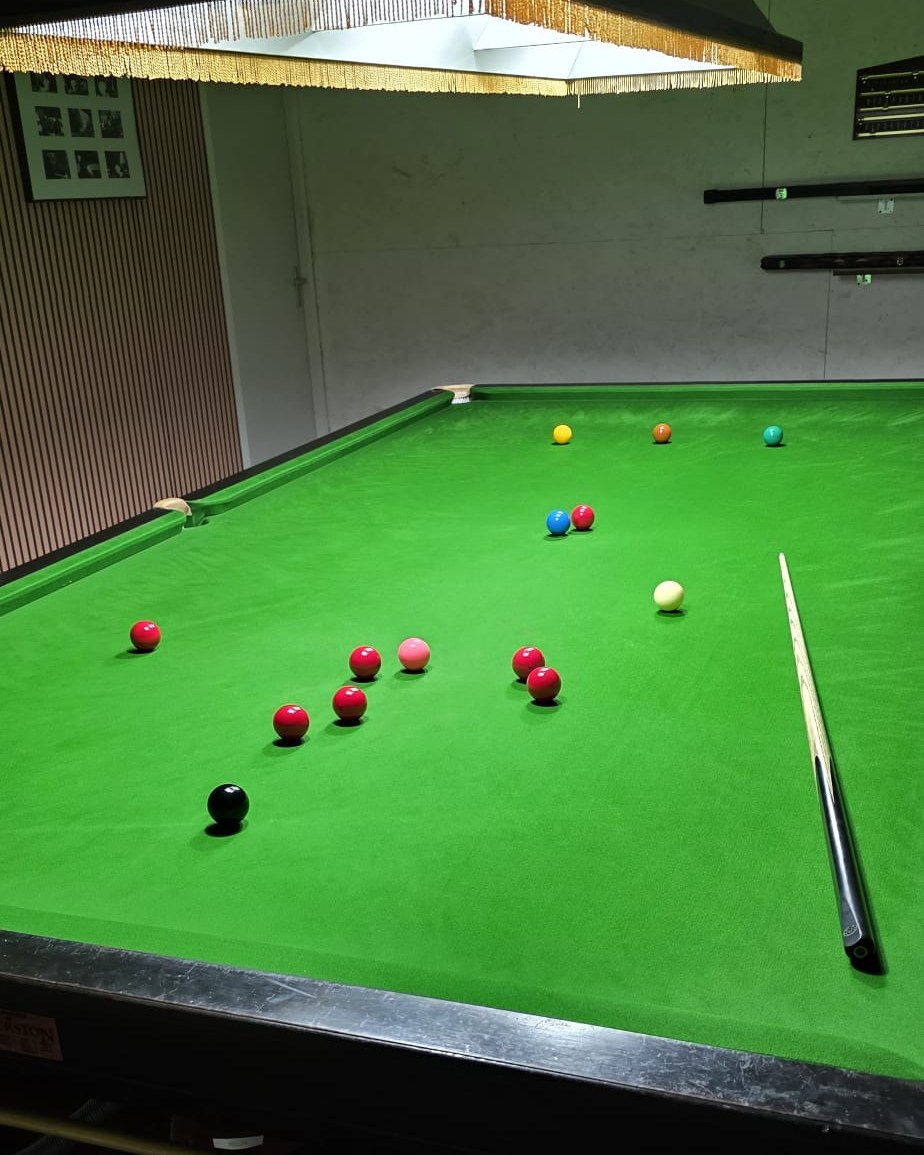
First, a quick explanation. Short work, or the short game, is everything around the reds and the colours when they are close together. Long work is, for example, a long pot, sometimes on a colour, to start a break or to keep one going.
1. Warm up, body included.
Snooker is a sport, and in every sport you warm up. Swing your arms for two or three minutes, do a few jumping jacks, loosen up your fingers and shoulders, and then knock a few balls in, however you like. I learned this the hard way, after two nasty bouts of bursitis.
2. Start with your basics, then spin the wheel.
Spend ten or fifteen minutes (longer is fine too, of course) on a fixed routine for things like your stance, your cueing and your concentration (if you have exercises for those), before you spin the wheel or move on to anything else. If you work with a coach, they'll get you off on the right foot.
3. My go-to: a lap of the table.
A high and a low black into both top corners. A low and a high pink into both middle pockets, and a high and a low pink into the corners. A sharp-angled blue into the baulk corners. The cue ball just past the blue (towards the pink), then the yellow and the green as recovery shots. The cue ball straight behind the blue (in line with the middle pocket), and the brown off its spot. Five or so of each, at least.
4. Mix short and long work.
If you're working on the short game, throw in a couple of long pots every ten minutes or so. Never more than five to ten long pots in a row, then back to three or four reds around the pink and the blue. Start every line-up, T line-up or X drill with a long pot as well, and if you miss the 10th or 11th red, set up two or three long pots around the black. Your body (and your mind) gets used to whatever you're doing, and during a frame that long pot comes out of nowhere too.
5. A line-up isn't about making a 147.
The point is cue ball control: the shots you face most often in the short game. Put a red above the black near the cushion, three reds on the far side of the blue towards the brown, and a red above the brown that can go either way. Breaks are fun, but this is about cue ball control, all around the table.
6. Get to know the whole table.
If I'm in perfect position on the black during a line-up, I'll sometimes take the pink anyway, because that's the one I miss a bit more often. Sometimes I start at the blue, or play most of it on the yellow, green and brown. In the end, it's about your all-round game.
7. Put the cue ball back roughly where it was.
When you practise a ball off its spot, put the cue ball back by hand roughly where it was, but don't be fussy about it, there's no need. You never get exactly the same shot during a match either. Sometimes it does help to replace everything exactly, to groove a particular angle, so don't skip that altogether, but most of your focus should be on small variations, while you keep practising mainly the same kind of angle and distance.
8. Set the table up like a match.
Always put all the colours on their spots, with a few loose reds spread around the table. If you're practising the brown, use the brown, not a red on its spot. Again, your body and your mind learn to recognise what they see, and you'll shoot yourself in the foot during a match. The same goes for practising long pots on an empty table: best avoided. Set the table up the way you'll most often find it during a match. Learn to deal with the distraction of other balls on the table, and keep it real.
9. Practise recovery shots, and the rest.
With the cue ball below the blue, take the yellow or the green and come back up to the red between the pink and the black, from both sides. If you get good position, go straight on into a small break. And if you need the rest, use it, because people practise with it far too little.
10. There's no such thing as an easy ball.
If there were, you'd never miss one. Put four reds either side of the blue spot, pot them into the middle pockets or one of the corners, off the cushions if you have to, and score one point per red.
You'll be amazed how hard it is to reach 100, 150 or 200, because that means potting an easy ball 100, 150 or 200 times. Around 80 or 90 the nerves start to creep in, or your concentration drops for a second without you even noticing, and that's when you rattle the jaws.
It took me well over an hour to reach 211. At 180 I was still telling myself I'd stop at 250, which would be plenty. But little by little my concentration faded, and I missed number 212. So close.
I'm really pleased with 211, and I won't be trying it again any time soon, because it's a mind-numbingly dull drill. But doing it properly once or twice a month helps the mental side too, and that's what part 2 of this short blog series is about.
Trust me, you'll want to read it.
In part 2: a plan, your mental game, and what you do before, during and after a match.
Ready to practise? The wheel picks your next drill, free and without an account.
Spin the wheel →